

Self-hosted · OpenAI-compatible
One endpoint in front of all your LLM keys.
Pool OpenAI, Anthropic, Gemini, OpenRouter, Mistral, Groq, Z.ai, xAI, GitHub Models and any OpenAI-compatible key. Let it pick the best model. Fail over automatically. Keep every conversation going across the switch.
- MIT licensed
- Python 3.11 | 3.12
- FastAPI + Redis
- Docker Compose
POST /v1/chat/completions  model=gpt-4o-mini  session=my-chat
  key openai-free-1   429 rate limited   rest 60s
  key openai-free-2   quota spent       wait for reset
  key openai-paid     200 ok           history carried over
reply returned · 1 request counted · 0 changes in your app
See what your keys are doing
The operator dashboard ships in the same container. Live traffic, key health, cost and latency, with no message content ever shown.
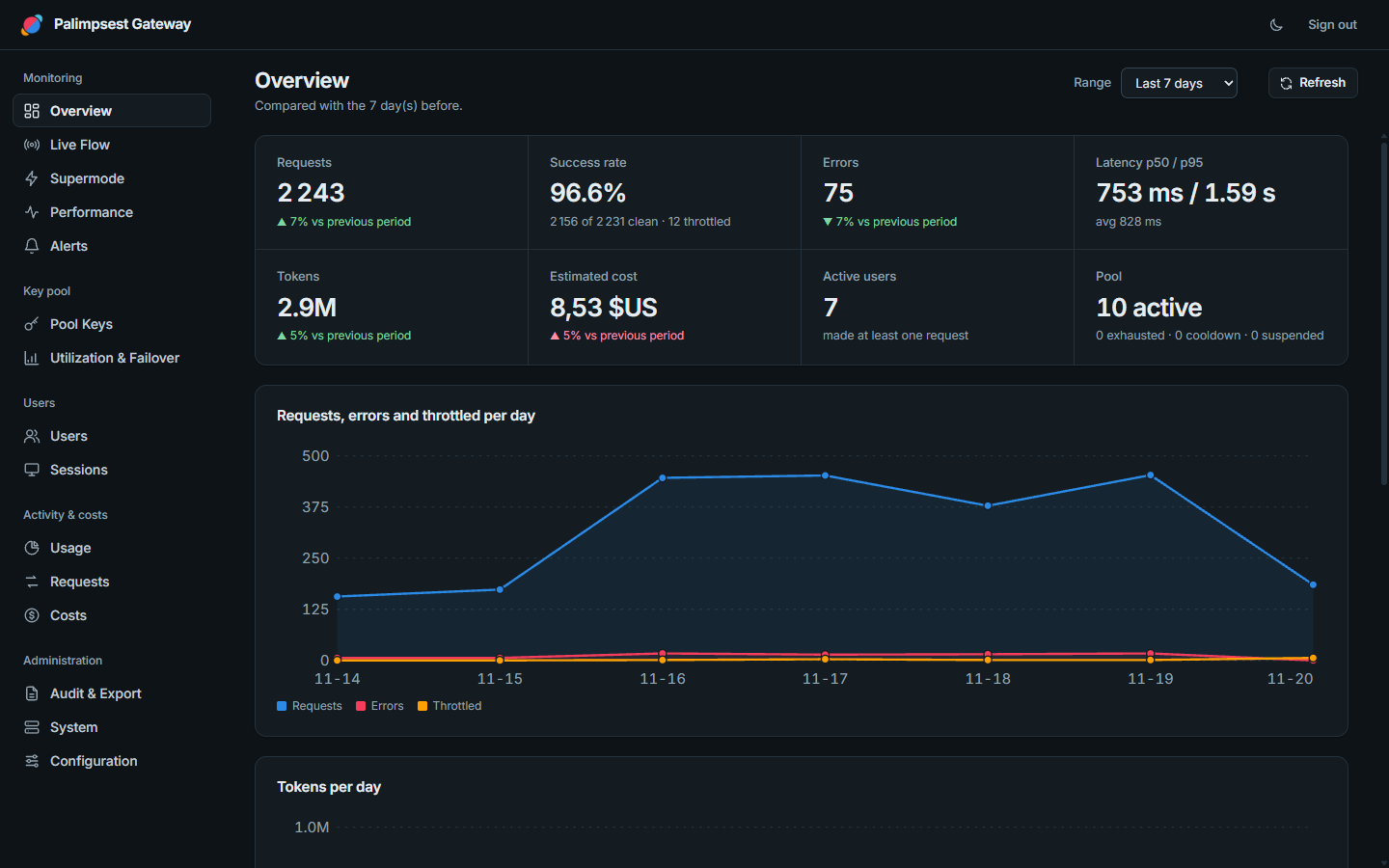
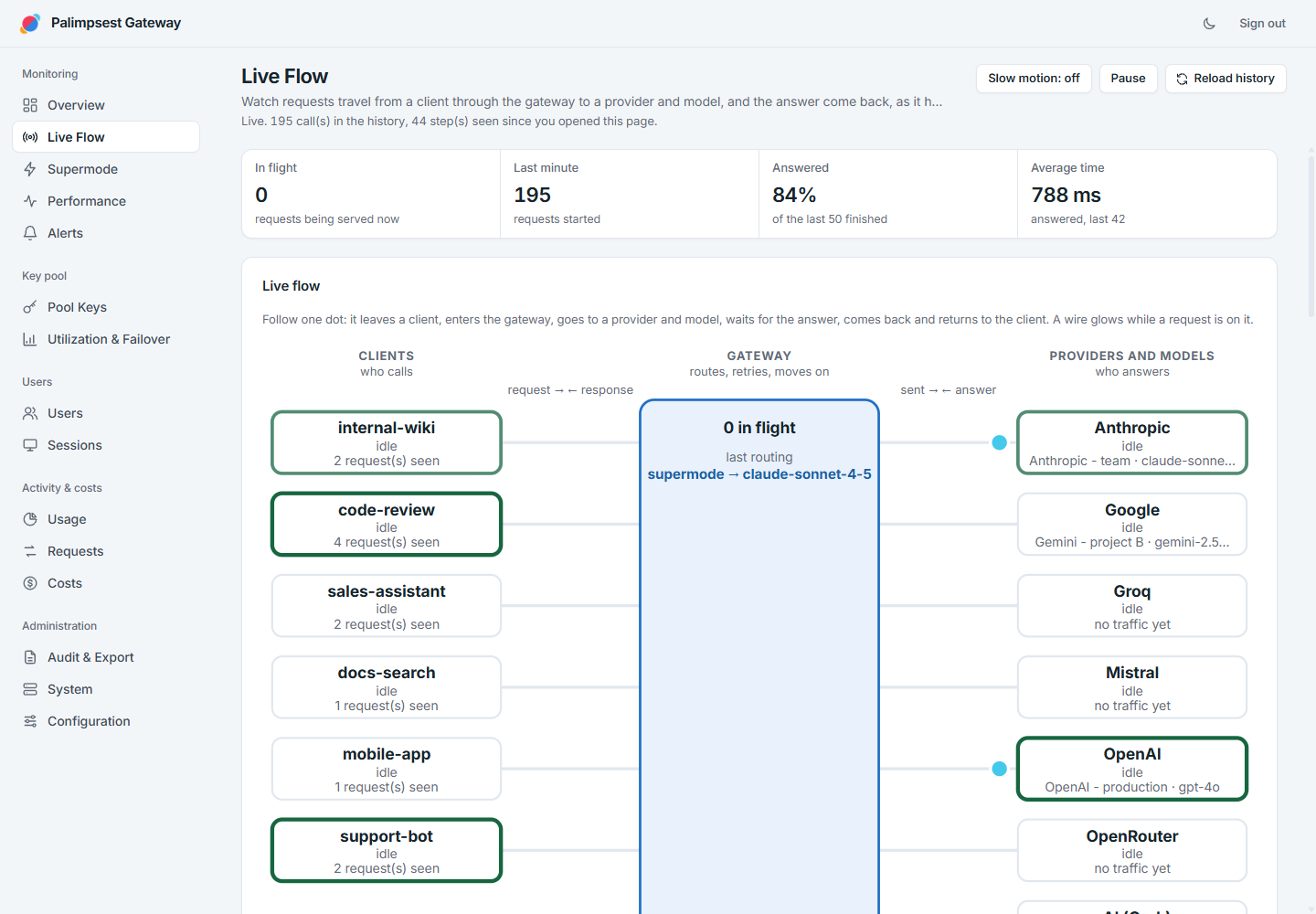
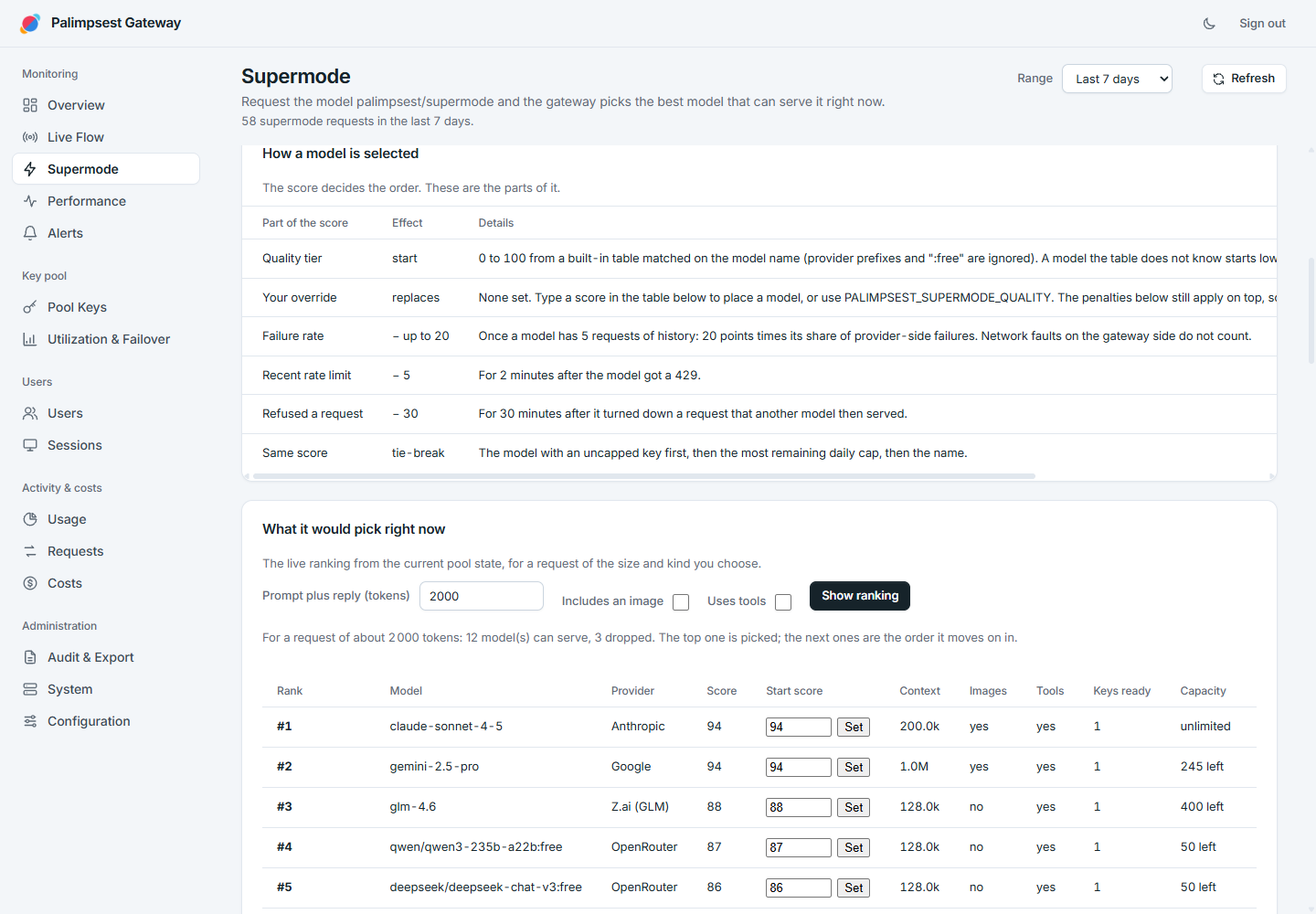
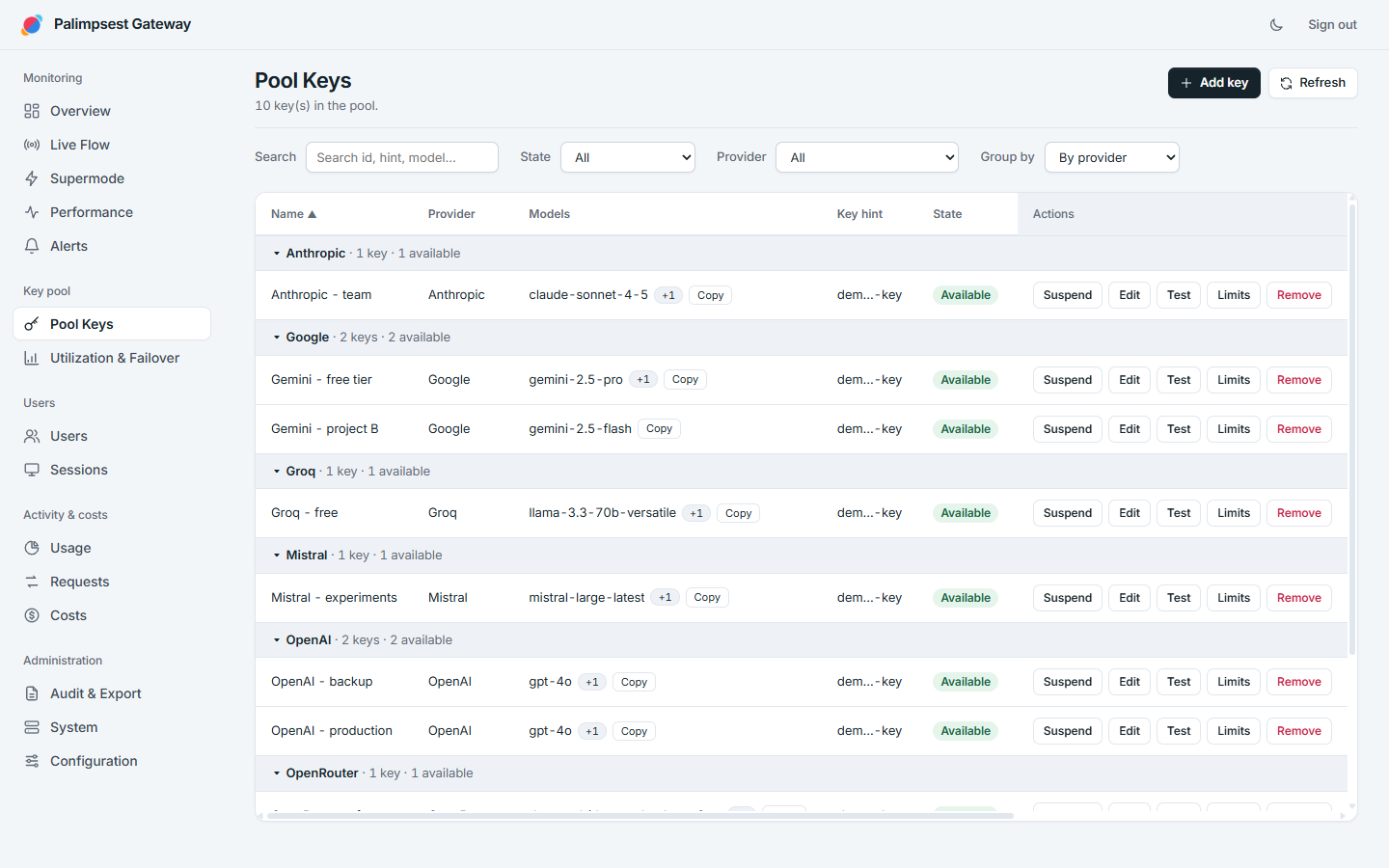
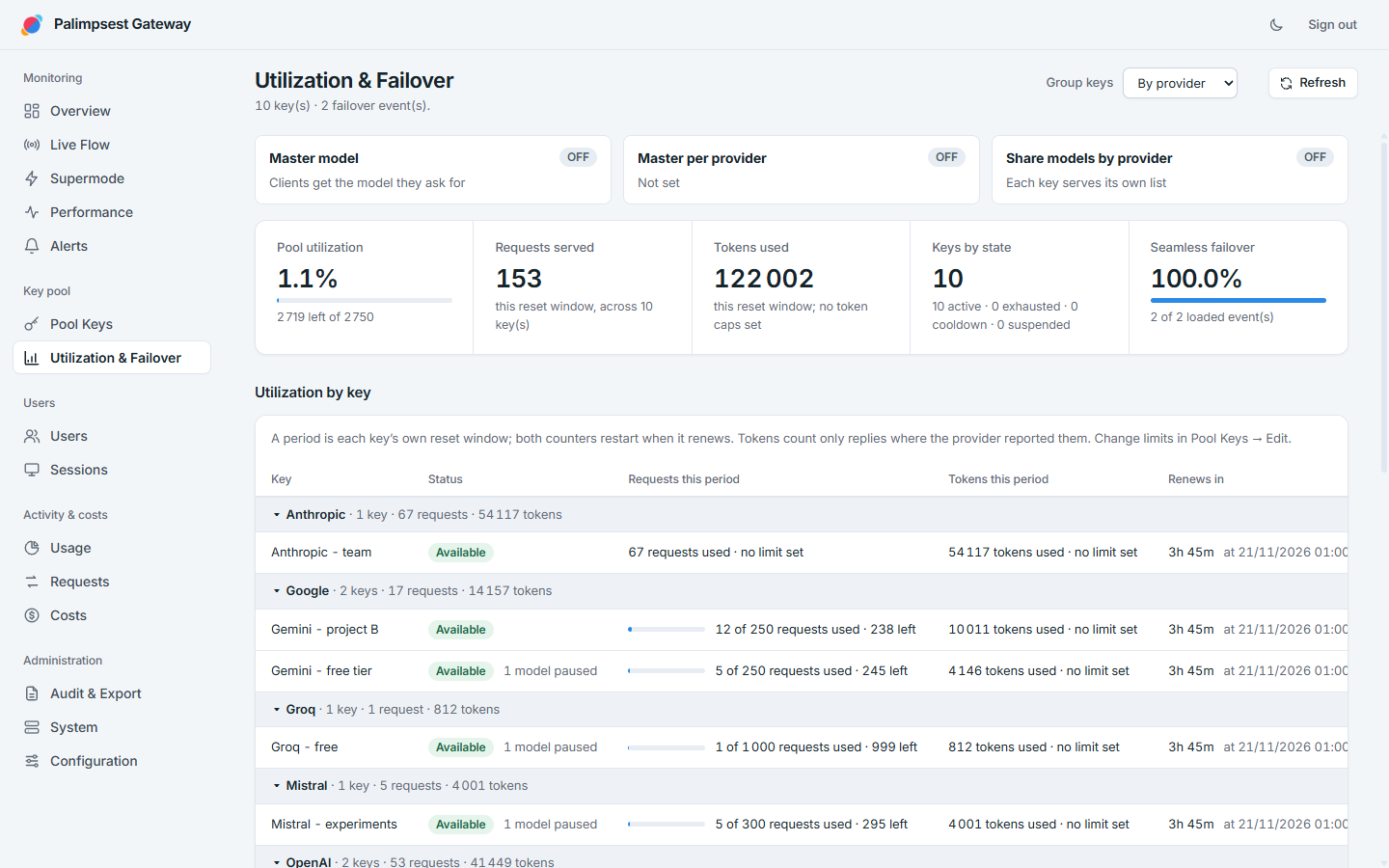
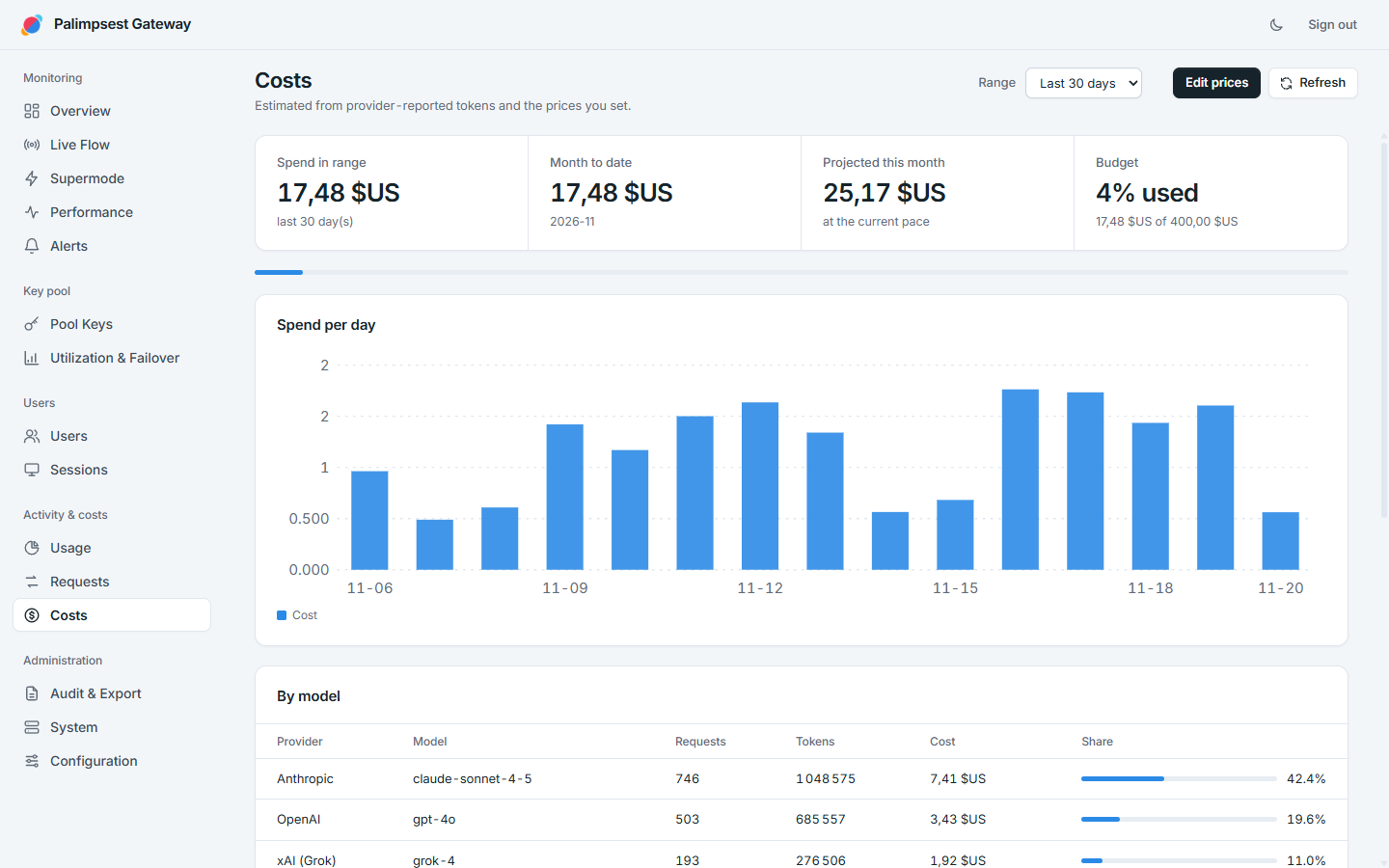
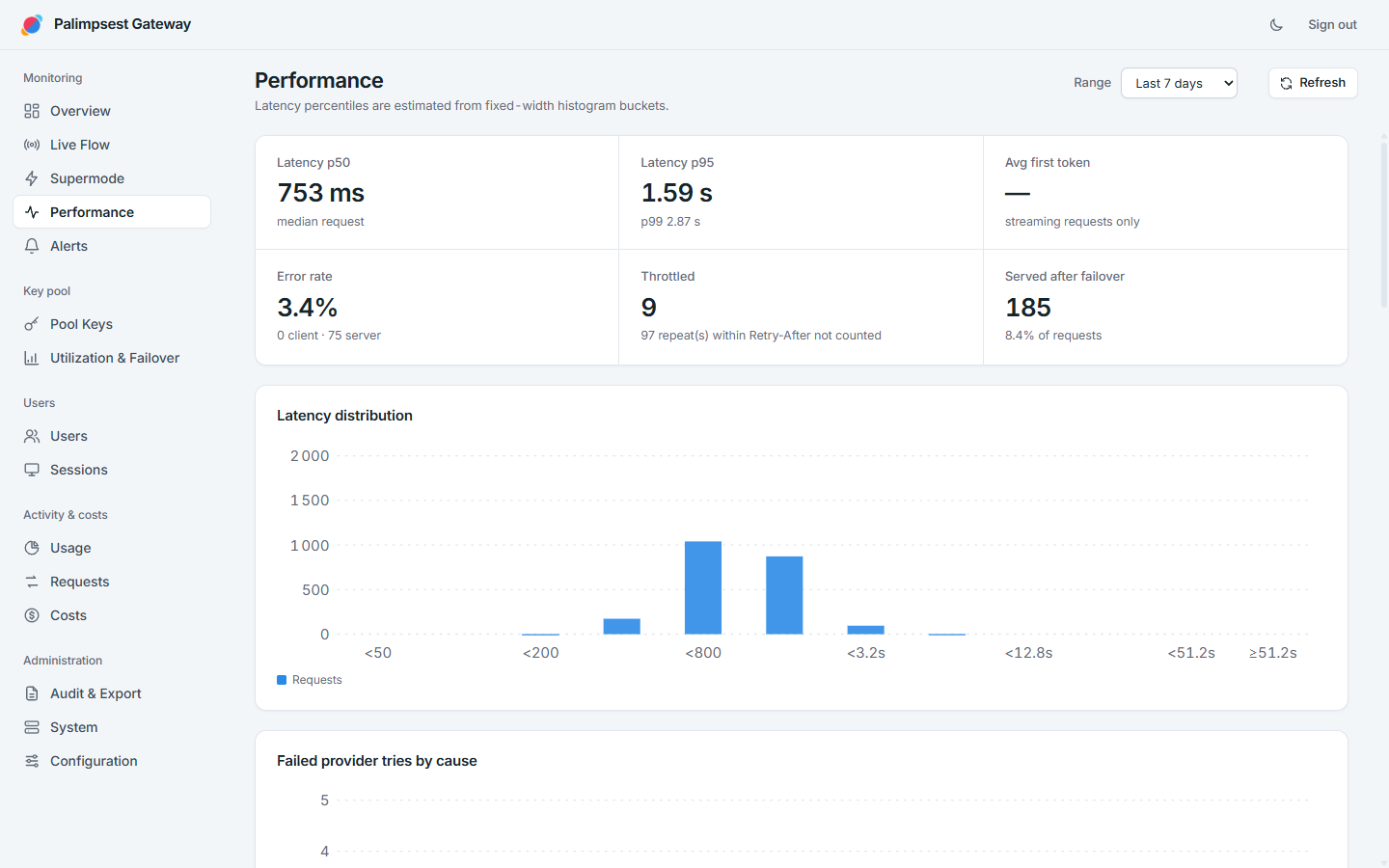
Screenshots use demo data: invented keys, users and traffic.
Your apps see one URL. Behind it, a pool.
Apps talk to the gateway exactly as they would talk to OpenAI. Provider keys never leave it.
Your app
Any OpenAI client, with a gateway key pgw_live_…
Palimpsest Gateway
Admit, load history, pick a key, fail over, meter usage.
Providers
OpenAI, Anthropic, Google Gemini, OpenRouter, Mistral, Groq, Z.ai, xAI, GitHub Models and custom endpoints.
- Authenticate. The app sends its own gateway key, never a provider key.
- Admit. Daily cap and remaining pool capacity are checked.
- Load context. With
X-Session-ID, stored history is added for you. - Choose a model and a key. Ask for
palimpsest/supermodeand the gateway picks the best model that can serve; then only active keys that serve it and aren't resting. - Fail over. Rate limit, outage or bad key: retry on the next key, same call. A provider in a real outage is skipped for a moment instead of hammered.
- Answer and record. Reply in OpenAI format, turn saved, usage counted once.
Features
Everything needed to run a shared key pool without every app re-implementing it.
- Drop-in OpenAI API
/v1/chat/completionswith streaming and tool calls, plus/v1/models.- Multi-provider pool
- Keys with optional request cap, token budget, reset schedule and label.
- Supermode
- Ask for
palimpsest/supermodeand the gateway picks the best model your pool can serve right now, across every provider and key, and moves to the next best if it fails. Pin a model's starting score from the dashboard. - Learns from traffic
- Context sizes, vision and tool support, model reliability and per-key rate limits are learned from what succeeds and what is refused, so the next request avoids what blocked this one.
- Live Flow
- Watch each request travel from a client through the gateway to a provider and model and back, with a history of every call and which key served which model.
- Provider protection
- A per-provider circuit breaker skips a provider in a real outage, and a concurrency gate caps requests in flight per provider. Neither spends a retry.
- Key tests
- Send one tiny real request through a key, or test every model of a key to find the ones the account can really use. A pass lifts a stale pause.
- Automatic failover
- Rate limits, outages and exhausted quotas are retried within a fixed budget. 503 with a retry hint when nothing is left.
- Conversation memory
- Per-user session history, so clients send only the new message and context survives a switch.
- Fairness controls
- Per-user daily caps and a pool low-water mark that throttles before the pool runs dry.
- Keys stay private
- Encrypted at rest, never returned after creation. Users only see generic errors and stable codes.
- Operator dashboard
- Key health and tests, usage, failovers, users, sessions, latency, costs, alerts and audit trail.
- Costs from your prices
- You enter per-model prices and a monthly budget. Nothing bundled, so nothing goes stale.
- Alerts and exports
- Low capacity, key problems, error rate, optional webhook. CSV export for usage, requests and audit.
- Observable
- One structured JSON log line per request, Prometheus metrics, and an ops view with provider and breaker state.
Quick start
Docker with Compose v2 is the only prerequisite. No .env, no manual key generation.
01Clone and run
git clone https://github.com/hammrouni/palimpsest-gateway.git
cd palimpsest-gateway
docker compose up -d --wait
API at localhost:8000, dashboard at /dashboard/, docs at /docs. First boot generates and persists a master key and an operator key.
02Add a provider key
echo 'PALIMPSEST_PROVIDER_API_KEY=sk-your-key' >> .env
docker compose up -d
Or add pool keys in the dashboard. Read the operator key with docker compose exec app cat /app/.secrets/operator_key.
03Create a user and call it
from openai import OpenAI

client = OpenAI(base_url="http://localhost:8000/v1", api_key="pgw_live_...")
reply = client.chat.completions.create(
    model="gpt-4o-mini",  # a model one of your pool keys serves
    messages=[{"role": "user", "content": "Hello"}],
)
print(reply.choices[0].message.content)
Create the user under Users → + New user; the key is shown once. Send the same X-Session-ID header to keep a conversation going server-side.
127.0.0.1:8000 by default and has no TLS or IP rate limiting. Before exposing it, set PALIMPSEST_BIND=0.0.0.0 behind a TLS reverse proxy, with PALIMPSEST_ALLOW_SIGNUP=false and a user daily cap.Paid keys, free keys, or both
The gateway tries keys that still have requests left first, most room first. Uncapped keys come last. Give limited keys a cap and they are used before the fallback.
| Paid keys | Add without a cap, or with a safety cap. Enter prices and a monthly budget under Costs, and turn on Alerts. |
|---|---|
| Free-tier keys | Set daily_cap at or below the published allowance with the matching reset period. Spent keys are skipped until reset. |
| Not a model host | It forwards to providers and runs no models. |
| Not a loophole | It uses only the keys you give it, within each key's limits. It does not lift provider limits. |
| Capacity | If every key is out of quota, clients get a 503 with Retry-After. |
| License | MIT |